

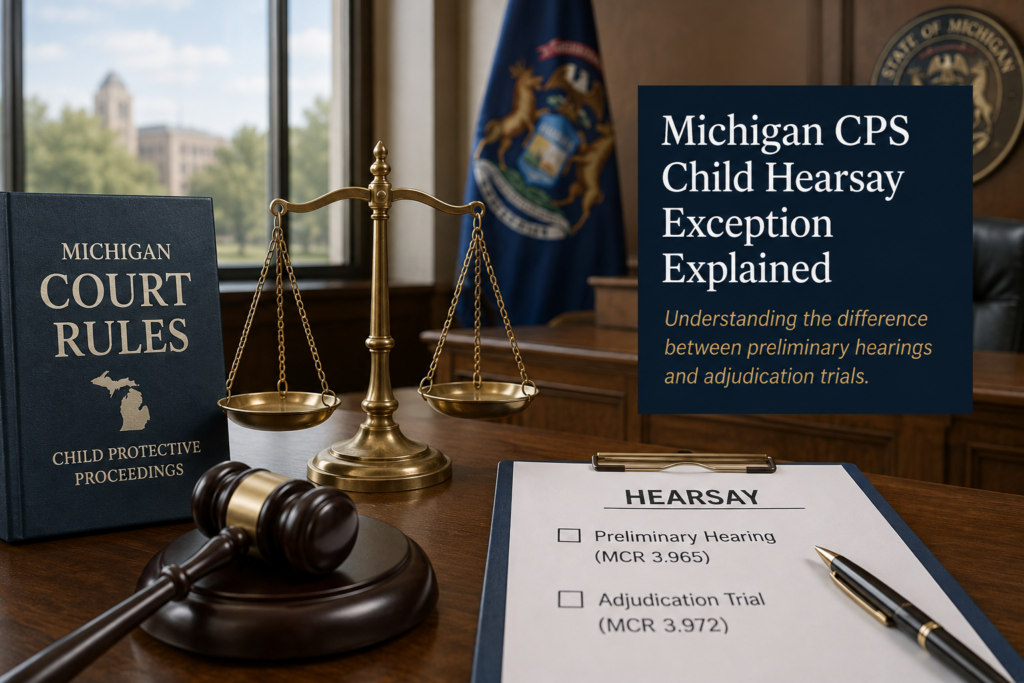
When a Child Protective Services (CPS) case begins, many parents are surprised to learn that a child’s out-of-court statement may influence what happens in court. Whether that statement can be considered depends on the stage of the child protective proceeding. Michigan law treats preliminary hearings differently from adjudication trials, and understanding that distinction is essential.
Hearsay at the Preliminary Hearing
A CPS case typically begins when the Michigan Department of Health and Human Services (MDHHS) files a petition asking the court to exercise jurisdiction over a child. If the agency is seeking to remove the child from the home, the court will conduct a preliminary hearing under MCR 3.965.
Unlike an adjudication trial, the Michigan Rules of Evidence generally do not apply at the preliminary hearing, except for privileges. The court’s immediate responsibility is to determine whether the petition should be authorized and whether the child should remain in the home, be returned home, or be placed in protective custody while the case is pending.
For placement decisions, MCR 3.965 allows the court to consider hearsay that has adequate indicia of trustworthiness. As a result, the court may hear testimony from a CPS worker about what a child reported or consider other reliable out-of-court statements when deciding whether temporary protective action is necessary.
The Rules Change at Adjudication
The evidentiary rules become much stricter once the case reaches the adjudication trial. Under MCR 3.972(C)(1), the Michigan Rules of Evidence generally govern the trial unless a court rule provides otherwise.
One important exception appears in MCR 3.972(C)(2). The rule creates a limited hearsay exception for certain statements made by a child under the age of 10, or by an incapacitated individual under the age of 18 with a developmental disability. Before the statement may be admitted, the court must determine that it possesses sufficient indicia of trustworthiness. The party offering the statement must also comply with the written notice requirements found in MCR 3.922(F).
Michigan appellate courts have explained that the trustworthiness determination requires the trial court to evaluate the totality of the circumstances surrounding the child’s statement. Factors may include the spontaneity of the statement, whether it was repeated consistently, the child’s mental state, the language used, and whether there is evidence suggesting a motive to fabricate.
Why This Distinction Matters
Parents sometimes assume that because a child’s statement was considered during the preliminary hearing, it will automatically be admitted at trial. Michigan law does not work that way. A statement that may support temporary placement under MCR 3.965 must still satisfy the separate evidentiary requirements that apply during adjudication.
Because child protective proceedings move quickly, legal issues involving hearsay should be evaluated early in the case. An attorney can determine whether the proper procedures have been followed, whether required notice was provided, and whether the statement meets the standards established by the Michigan Court Rules.
If your family is involved in a Michigan CPS proceeding, experienced legal representation can help ensure that the court applies the correct evidentiary rules at every stage of the case. The attorneys at The Kronzek Firm represent parents throughout Michigan and work to protect their rights during child protective proceedings.
Frequently Asked Questions
Can CPS use a child’s statement if the child does not testify?
Yes. During a preliminary hearing under
MCR 3.965, the court may consider hearsay when making certain decisions, including placement, if the statement has adequate indicia of trustworthiness. Different evidentiary rules apply at the adjudication trial.
Does the Michigan Rules of Evidence apply in every CPS hearing?
No. The Michigan Rules of Evidence generally apply at the adjudication trial under MCR 3.972(C)(1). They generally do not apply at the preliminary hearing, except for privileges, as provided in MCR 3.965.
What is the child hearsay exception in a Michigan CPS case?
MCR 3.972(C)(2) permits the admission of certain out-of-court statements made by a child under the age of 10, or by an incapacitated individual under 18 with a developmental disability, if the court determines the statement has sufficient indicia of trustworthiness and the rule’s notice requirements have been satisfied.
Is written notice required before a child’s hearsay statement can be admitted?
Yes. MCR 3.922(F)
requires written notice of the intent to offer the statement, along with other information specified in the court rule.
Why does the hearing stage matter?
Each stage of a Michigan CPS case serves a different purpose. A statement that may be considered during a preliminary hearing is not automatically admissible at the adjudication trial, where different evidentiary requirements apply.